Commentary
Candidate status for Ukraine and Moldova changes what enlargement means
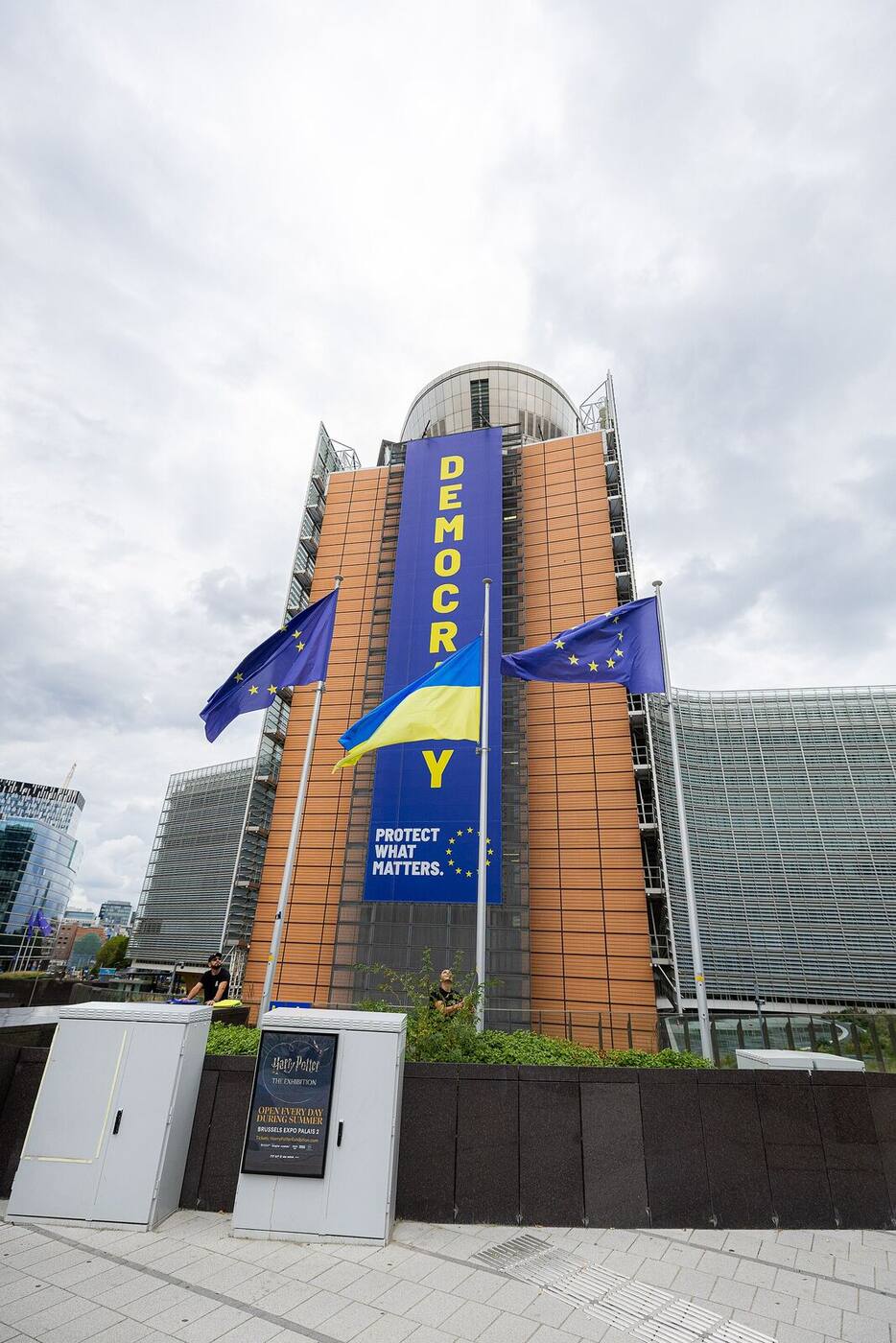
On 23 June 2022 the European Council decided to grant the status of candidate country to Ukraine and to the Republic of Moldova[1]. In the same conclusions it recognised the European perspective of Ukraine, Moldova and Georgia, and it declared itself ready to grant candidate status to Georgia once the priorities identified by the Commission have been addressed[1]. Ukraine had applied on 28 February 2022, four days into the Russian invasion, and the Council had asked the Commission for its opinion on 7 March[2]. The Commission adopted its three opinions on 17 June[3]. Parliament adopted a resolution in support on the morning of 23 June by 529 votes to 45, with 14 abstentions[4]. Charles Michel called the decision "a historic moment", and Olaf Scholz summed up the vote with "27 times yes!"[5].
Four months separate the application from the status. For our generation it is the first enlargement decision we can call our own. We were children in 2004, when ten states joined. We are adults now, and the applicant is a state at war whose students sit the same exams we sat, in shelters.
A status with conditions attached
Candidate status is a political act with legal consequences. Under Article 49 of the Treaty on European Union, any European State that respects the Union's values may apply; the Council decides unanimously after consulting the Commission and obtaining Parliament's consent, and the accession treaty is ratified by every Member State[6]. The European Council's decision opens that road. It does not shorten it.
The Commission's opinion on Ukraine lists seven steps[2]. Ukraine must adopt and implement legislation on the selection of Constitutional Court judges, complete the integrity vetting of candidates to the High Council of Justice, strengthen the fight against high-level corruption and appoint the heads of the Specialised Anti-Corruption Prosecutor's Office and the National Anti-Corruption Bureau, align anti-money laundering legislation with FATF standards, implement the anti-oligarch law in a legally sound way, adopt a media law aligned with the Audiovisual Media Services Directive and finalise the legal framework for national minorities[2]. The Commission notes that Ukraine has met about 80 per cent of the Venice Commission's recommendations[3]. For Moldova the Commission names the economy and public administration as the areas that need the largest improvement[3]. For Georgia it asks the political leaders to agree on a path towards structural reform that involves civil society and commands broad support[3].
The conclusions attach a procedure to those conditions. The Commission is invited to report to the Council on their fulfilment, and the Council will decide on further steps once they are met[1]. Progress "will depend on its own merit in meeting the Copenhagen criteria"[1]. Integration proceeds "in a reversible and merit-based manner"[1]. Türkiye received candidate status in December 1999 and has not moved since[5]. A status is a name. A negotiation is work.
We think the conditions are the right ones. A country fighting for its survival cannot vet judges at the pace it would in peacetime. It can, however, appoint the two anti-corruption chiefs whose appointment the Commission requests[2]. The seven steps ask Kyiv for things within its reach.
The Balkan mirror
The same morning, the leaders of the six Western Balkan states met the European Council in Brussels. Before the meeting Edi Rama, Prime Minister of Albania, told reporters that "you are a big mess and you are a disgrace"[7]. His anger had a cause. Bulgaria's veto blocked the opening of accession negotiations with North Macedonia, and Albania's negotiations are coupled to them[7]. The conclusions call for a "swift resolution of the last remaining issues" between Sofia and Skopje[1]. They also say the Union is "ready to grant the status of candidate country to Bosnia and Herzegovina" once the Commission reports on the fourteen key priorities[8].
On 24 June the Bulgarian parliament voted by 170 to 37, with 21 abstentions, to lift the veto on the basis of the French compromise, which provides that the negotiating framework shall not contain wording that could be read as Bulgarian recognition of a Macedonian language[9]. North Macedonia answered that its identity and language are "not open for discussion", and its own parliament must still approve the compromise[9]. Skopje has held candidate status since 2005. A 17-year-old in Skopje has spent her entire life as a citizen of a candidate country.
That is the mirror the Balkans hold up to Kyiv and Chișinău. Macron said in Strasbourg on 9 May that Ukraine's accession would take "several decades"[10]. The 23 June conclusions also record a discussion of his proposed European political community, and they state that it "will not replace existing EU policies and instruments", in particular enlargement[8]. A platform for dialogue can become a waiting room. The Western Balkans have been in one for seventeen years.
The conclusions also commit the Union to concrete support. The Commission will propose exceptional macro-financial assistance of up to EUR 9 billion for Ukraine in 2022[8]. The Council urges Russia to "unblock the Black Sea, in particular the port of Odesa", and it backs the Solidarity Lanes that move Ukrainian grain by land[8]. The Council is asked to work swiftly on a further increase of military support[8]. Candidate status therefore sits inside a package. It is not a consolation prize for a country the Union cannot defend.
We draw four conclusions. The Commission should deliver its first report on the seven steps for Ukraine and the conditions for Moldova before the end of 2022, so that the European Council in December can act on evidence. The Council should open accession negotiations with North Macedonia and Albania as soon as the parliament in Skopje has acted on the French compromise, because every month of delay is read in Tirana as a double standard. The Member States should extend Erasmus+ and youth mobility to Ukrainian and Moldovan students this academic year, since candidate status without contact is an empty label for an 18-year-old in Chișinău. The European Council should state in December what the European political community is for and whom it serves, so that no candidate mistakes it for a substitute.
Note
Citați
Global Policy Centre, "Candidate status for Ukraine and Moldova changes what enlargement means", Génération Maastricht, 27 June 2022, https://generationmaastricht.org/research/ukraine-moldova-candidate-status-june-2022.